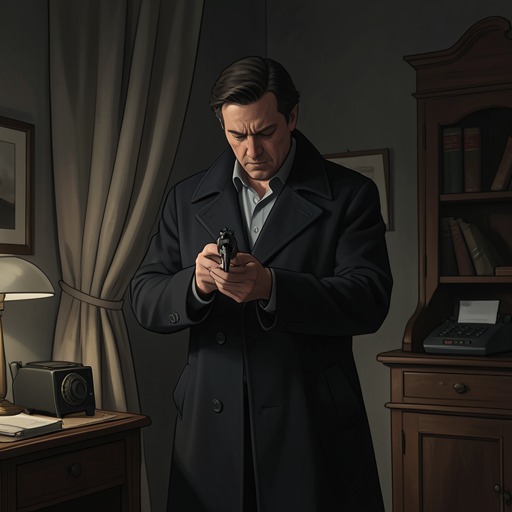
Rudi Scherz’s revolver
A Murder Is AnnouncedRudi Scherz’s revolver is the weapon whose report turns the staged hold-up at Little Paddocks from a performance into a death. Before its shots, the room responds to the intruder’s flashlight and barked commands with eager, even delighted participation; once the gun fires, that shared fiction collapses. The revolver’s place in the scene is therefore both physical and dramatic: it causes the fatal crisis while exposing how little the witnesses can reliably say about what happened.
Appearance and Use in the Hold-Up
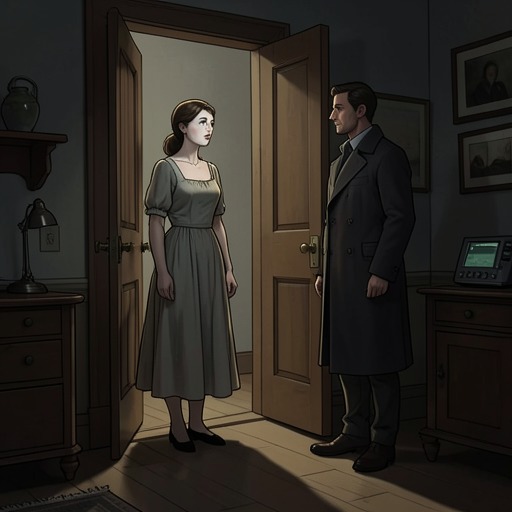
The revolver enters the scene as part of a performance shaped by familiar crime-film conventions. A powerful flashlight sweeps across the room as a hoarse, nasal voice orders the company to put their hands up. The occupants comply willingly, and one voice expresses excitement. The weapon’s shots overturn that response: it fires twice, and the sound shatters the room’s complacency. What had seemed a safe imitation of a robbery is suddenly no longer merely a game.
The sequence leaves the weapon’s action difficult to reconstruct. The masked figure in the doorway whirls around, seems to hesitate, and a third shot rings out before he crumples. The flashlight falls and goes dark; the drawing-room door swings shut and latches. In the sudden darkness, the revolver is associated not with a clear, witnessed act but with a chain of movements whose order and cause remain uncertain.
The Death and Its Uncertainty
When the light returns, the fallen figure is wearing a black cloak with a hood, a black mask, and black cotton gloves. The hood has slipped back, revealing fair, ruffled hair. Colonel Archie Easterbrook turns the man over, checks for signs of life, and draws back sticky, bloodied fingers. His immediate conclusion is that the man has shot himself, but he cannot establish whether the death was deliberate or accidental: the cloak may have caused the man to trip as he fell.
The preliminary medical report does not resolve the ambiguity. It establishes that the revolver was discharged at close range, with singeing, but offers no way to determine whether the shot was intentional or the result of a fall. The report considers both possibilities and tentatively favors an accidental discharge. The revolver thus leaves the central question open at the scene: the death is certain, but its exact mechanism is not.
Evidence and Narrative Significance
Witnesses, Evidence, and the Limits of Seeing
The revolver’s uncertain discharge becomes a test of testimony as well as a forensic problem. Sir Henry Clithering observes that people under intense excitement and nervous strain may see different things, and may fail to see others altogether. Inspector Craddock expects that the witnesses will each report a different version. Their contradictory perspectives matter because the room has moved in seconds from willing participation in a mock robbery to shock at actual gunfire; the scene offers no neutral, continuous view of how the fatal shot was fired.
The preliminary medical findings narrow the possibilities without settling them. The close-range discharge and singeing are consistent with a deliberate shot, but the report cannot distinguish that from a revolver going off as its holder falls. The tentative preference for accident is explicitly provisional, not a definitive reconstruction. At this point, the weapon supplies physical evidence of a close-range firing while leaving intention unresolved.
Dramatic Function and Limits
The revolver’s role is defined by the abrupt break it makes between acted danger and actual death. The occupants have treated the flashlight and the intruder’s commands as entertainment; the shots strip away that shared expectation, and the masked figure falls as the light goes out. The weapon is not simply a prop in the apparent hold-up: its firing changes the scene’s stakes irreversibly, leaving a dead man where the participants had expected a game to continue.
Yet the revolver does not make the event transparent. The witnesses have seen the room in fragments: a figure turning, an apparent hesitation, a shot, a fall, and darkness. Even the medical report can establish only that the gun fired at close range, with singeing; it cannot say whether the discharge was deliberate or accidental. Sir Henry Clithering’s observation about what people notice under strain gives this uncertainty a larger narrative purpose: the weapon supplies a hard fact, but not a complete account, making the gap between physical evidence and human interpretation central to the mystery.